Our advanced activated carbon solutions are built for a wide range of uses, helping mining and industrial operations run more efficiently with reliable and consistent performance.
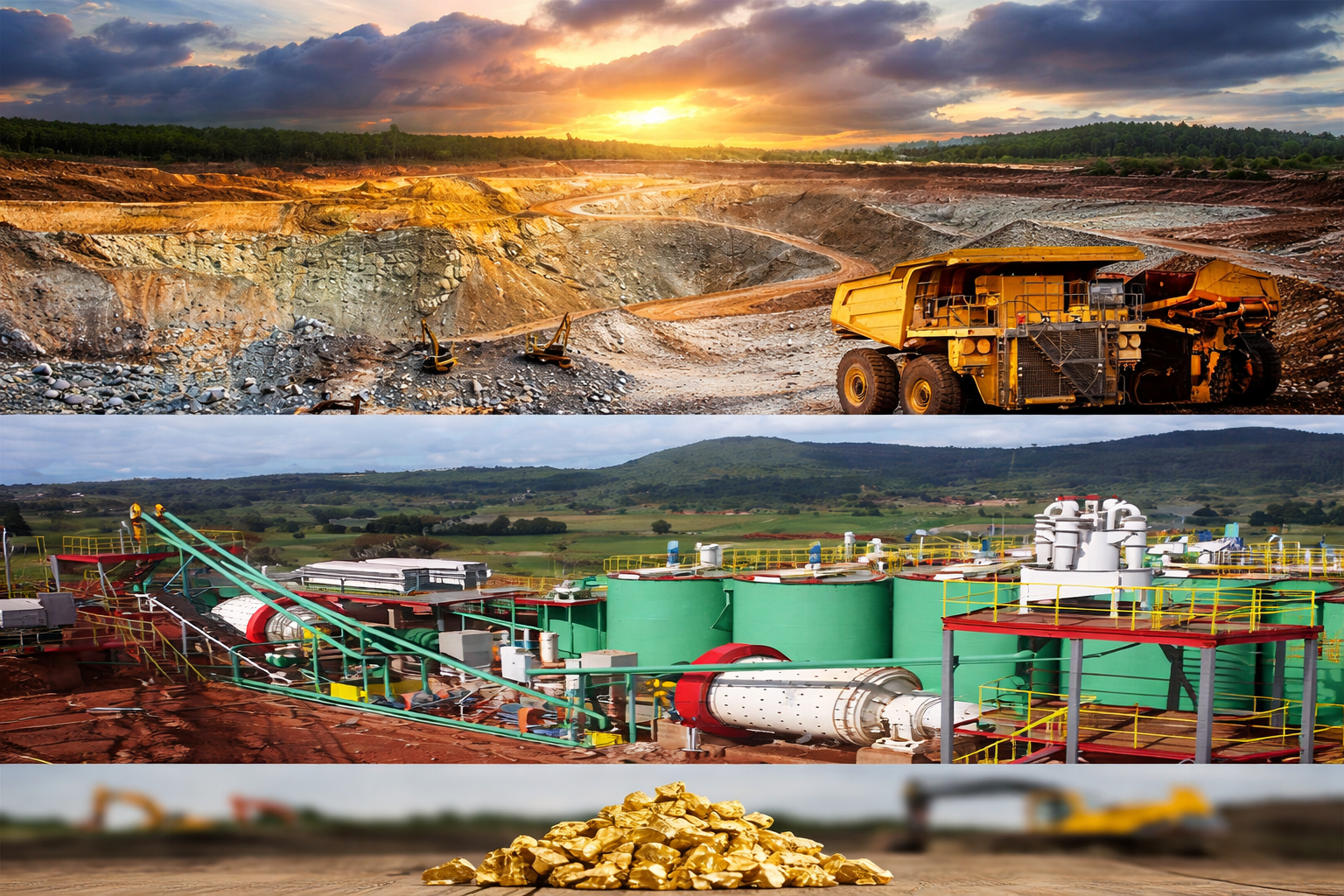
Activated Carbon For Gold Mining Applications
Common Gold Recovery Systems Using Activated Carbon
-
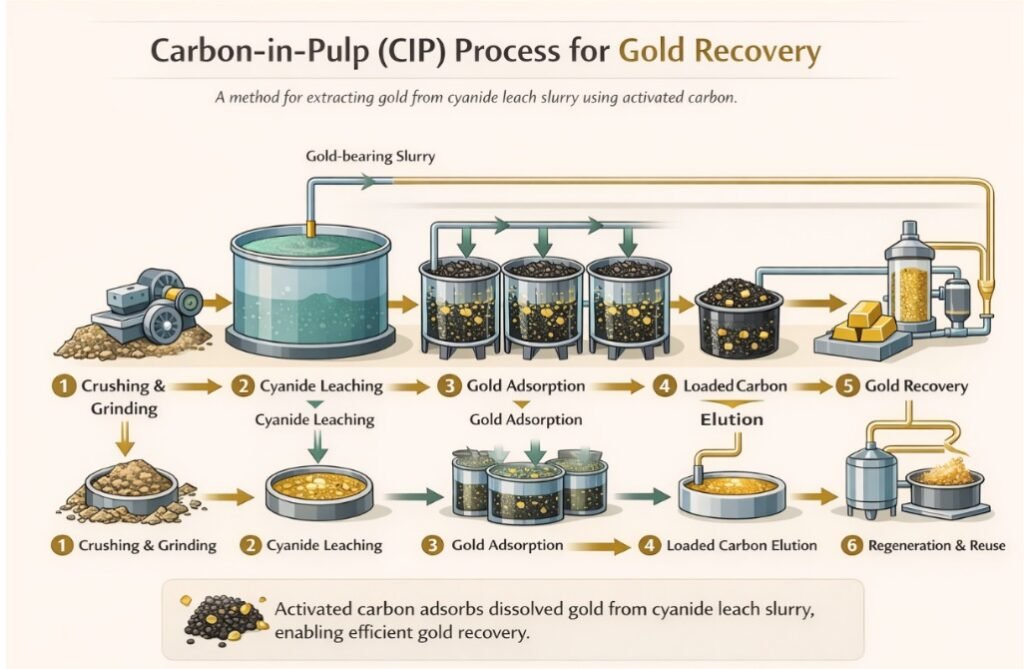
CIP (Carbon-in-Pulp)
: Carbon is added after leaching and gold is adsorbed from the pulp. -
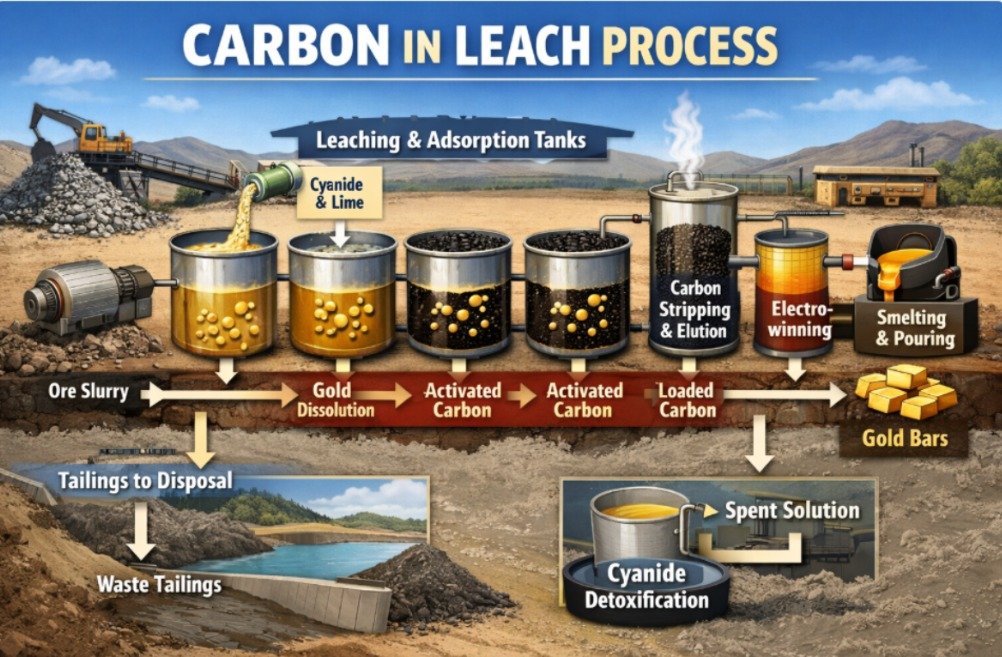
CIL (Carbon-in-Leach)
: Carbon is added during leaching—adsorption and leaching happen simultaneously.
3. CIC (Carbon-in-Column)
: Used for clear solutions (like heap leach solutions) where the gold is adsorbed as it flows through carbon columns.1. Carbon in Pulp (CIP)
In The Carbon In Leach (CIL) Process, gold Is first dissolved from The ore using A cyanide Leaching Solution. The Resulting Gold-Bearing Slurry Is Then Contacted With Activated Carbon In A Series Of Adsorption Tanks.
Leaching and adsorption are carried out as separate process steps, allowing greater control over gold recovery. Activated carbon moves counter-current to the slurry flow, maximizing gold loading efficiency. The loaded carbon is subsequently stripped and regenerated for reuse.
Best suited for:
High-grade ores and large-scale gold processing plants requiring high recovery efficiency.
Coconut Shell–based Activated Carbon is the industry-preferred Adsorbent for Gold Recovery in cyanide leaching operations. Owing to its exceptionally hard structure, high microporosity and superior adsorption kinetics, it delivers consistent and efficient recovery of dissolved gold from leach solutions.
Produced from renewable Coconut Shells, this grade of Activated Carbon offers high mechanical strength, low attrition loss and long service life, making it ideal for repeated loading, elution, reactivation and reuse in gold mining circuits. Its chemical stability in alkaline and cyanide environments ensures reliable performance under demanding operating conditions.
Activated Carbon is used in three principal gold recovery processes, depending on ore type, grade and operational requirements.
2. Carbon in Leach (CIL)
The Carbon in Leach (CIL) process combines cyanide leaching and gold adsorption in a single stage. Coconut shell–based activated carbon is added directly to the leaching tanks, where gold dissolution and adsorption occur simultaneously.
This integrated approach reduces equipment requirements, shortens processing time and improves overall operational efficiency, especially for ores with fast leaching characteristics.
Best suited for:
Operations seeking simplified plant design, reduced capital cost and faster gold recovery.
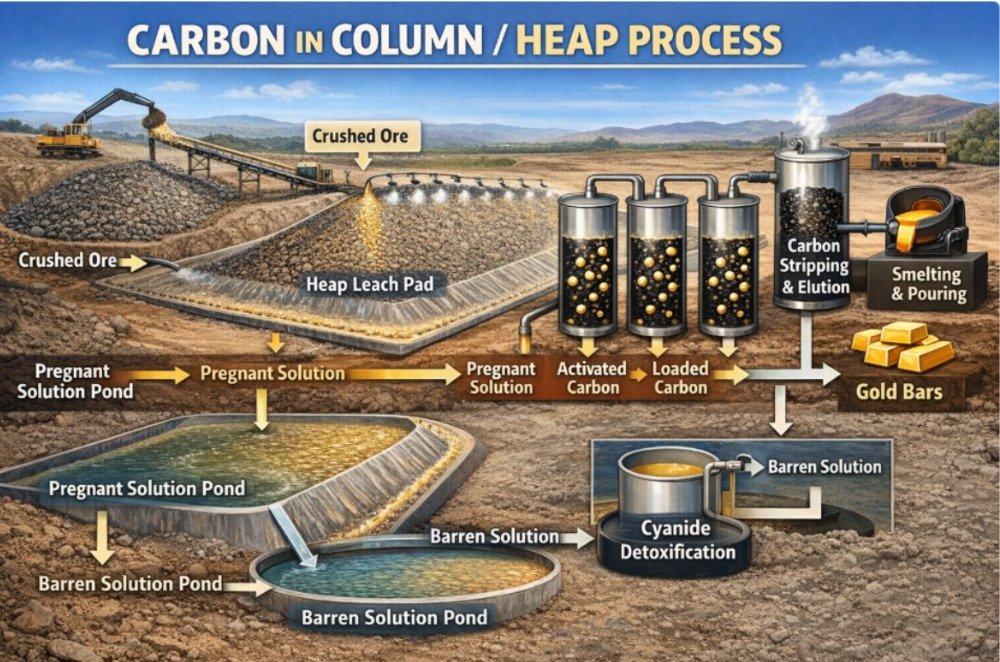
3. Carbon in Column (CIC) / Heap Leach
The Carbon in Column (CIC) process is widely used in heap leach operations. Crushed ore is stacked on leach pads and irrigated with cyanide solution. The gold-bearing solution collected from the heap is passed through columns filled with activated carbon, where gold is adsorbed.
Loaded carbon is periodically removed for elution and regeneration. This method is particularly effective for processing large volumes of low-grade ore.
Best suited for:
Low-grade deposits, heap leach operations and cost-efficient large-tonnage mining projects.
Key Salient Features for Gold Mining Applications
- Raw Material: Made from coconut shells, a renewable and sustainable resource.
- Micro porosity: High proportion of micropores (pores <2 nm), suitable for trapping small molecules like gases and volatile organic compounds.
- Hardness: High mechanical strength, meaning it does not easily break during handling or use.
- Low Ash Content: Less impurity, better efficiency in filtration and chemical reactions.
- Surface Area: Typically between 900–1200 m²/g, depending on the activation process.
Production Process of Activated Carbon for Gold Mining Applications
- Carbonization: Coconut shells are heated in the absence of air to form char.
- Activation: Char is treated with steam or chemicals (e.g., phosphoric acid, potassium hydroxide) at high temperatures (600–900°C) to develop its porous structure.
Why Activated Carbon Works for Gold Adsorption
1.Highly Porous Structure:
- Activated carbon has an extremely high surface area (500–1500 m²/g).
- The internal pores provide sites for the gold-cyanide complex to adsorb.
2.Hydrophobic Interactions:
- Gold-cyanide complexes are slightly hydrophobic.
- Activated carbon is also hydrophobic, so the complexes are attracted to and retained on the carbon surface.
3.Van der Waals and Electrostatic Forces:
- Weak forces help hold the gold complexes on the carbon.
- In CIP/CIL systems, the carbon is kept in contact with the slurry for enough time for maximum adsorption.
4.Selective Affinity:
- Activated carbon shows a higher affinity for [Au(CN)_2]^− compared to many other metal cyanide complexes, making it selective and efficient for gold recovery.
What Happens After Adsorption.
1.Elution:
- The gold is stripped from the carbon using a hot caustic solution.
- This produces a concentrated gold-bearing solution.
2.Electro winning or Precipitation: ·
- Gold is recovered from the solution via electro winning or chemical precipitation.
3.Carbon Regeneration:
- The stripped carbon is thermally regenerated (often in a kiln) to remove any residual organics or contaminants, restoring its adsorption capacity.