ADSD Consulting Private Limited

Turnkey EPC Projects: Benefits, Process & Why Industries Prefer a Single-Point Solution
Industrial projects demand precision, coordination, and technical expertise. Whether building a manufacturing plant, chemical processing facility, renewable energy project, or industrial infrastructure, businesses need a delivery model that minimises risks. In contrast, ensuring projects are completed on time and within budget.
This is where Turnkey EPC Projects have become the preferred choice for industries worldwide. Instead of managing multiple contractors, suppliers, consultants, and construction teams separately, organisations work with a single EPC contractor responsible for the entire project—from engineering and procurement to construction, testing, and final handover.
The term “turnkey” means that once the project is completed, the client can simply “turn the key” and begin operations immediately. Every aspect of the project is managed by the EPC contractor, allowing businesses to focus on their core operations while reducing coordination challenges and project risks.
In this guide, we’ll explore how turnkey EPC projects work, their advantages, industries that rely on them, and why they have become the preferred project delivery model for modern industrial development.
What Are Turnkey EPC Projects?
A Turnkey EPC Project is a project delivery model in which a single contractor assumes full responsibility for engineering, procurement, construction, testing, and commissioning until the project is fully operational.
Unlike traditional project execution models, where separate organizations handle different phases, a turnkey EPC contractor manages the complete lifecycle under one agreement.
This integrated approach offers clients greater convenience, improved accountability, and a more efficient path from concept to completion.
Turnkey EPC projects are commonly used for:
- Manufacturing plants
- Chemical processing facilities
- Oil & gas infrastructure
- Renewable energy projects
- Water treatment plants
- Pharmaceutical facilities
- Warehouses and logistics parks
- Industrial utilities
By assigning complete responsibility to one contractor, businesses reduce the complexity of managing multiple vendors while improving communication and project coordination.
How Does a Turnkey EPC Project Work?
Although every industrial project has unique requirements, most turnkey EPC projects follow a structured process that ensures smooth execution and timely completion.
1. Project Planning
Every project begins with understanding the client’s objectives, technical requirements, production capacity, budget, and project timeline.
Activities during this phase include:
- Site assessment
- Feasibility studies
- Risk evaluation
- Budget estimation
- Project scheduling
- Regulatory review
Proper planning helps identify potential challenges before engineering work begins.
2. Engineering and Design
After project planning, engineers develop detailed technical designs that serve as the foundation for procurement and construction activities.
Engineering typically includes:
- Civil engineering
- Structural engineering
- Mechanical engineering
- Electrical engineering
- Instrumentation
- Process engineering
- Plant layout
- Utility planning
- 3D modelling
Accurate engineering improves construction efficiency while reducing costly modifications during project execution.
Businesses looking for integrated engineering support can explore ADSD Group’s Engineering & EPC Services for customised industrial project solutions.
3. Procurement
Procurement ensures that all equipment, machinery, structural materials, electrical components, and industrial systems are sourced from reliable suppliers.
An experienced EPC contractor follows a structured procurement process involving:
- Vendor qualification
- Technical evaluation
- Commercial negotiation
- Purchase orders
- Material inspections
- Factory Acceptance Testing (FAT)
- Logistics planning
- Delivery coordination
Timely procurement prevents construction delays and improves project efficiency.
A reliable industrial supply chain plays a crucial role in ensuring materials are delivered on time and construction activities continue without interruption.
4. Construction and Installation
During this phase, the project moves from planning to execution.
Construction activities include:
- Civil works
- Structural steel erection
- Mechanical installation
- Electrical installation
- Instrumentation
- Utility systems
- Equipment installation
- Safety inspections
Throughout construction, project managers monitor quality, safety, progress, and costs to ensure successful project delivery.
Why Businesses Choose Turnkey EPC Projects
The popularity of turnkey EPC projects continues to grow because they simplify project execution while reducing administrative burden for clients.
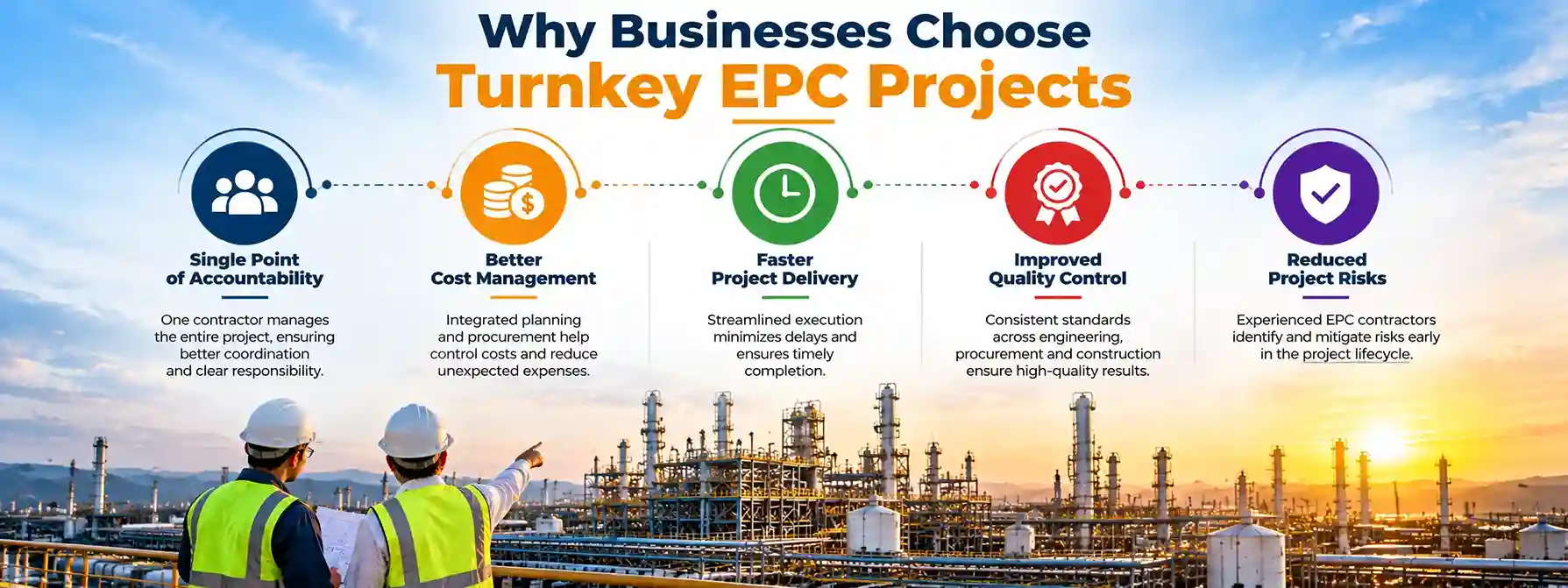
Some of the primary reasons industries choose this approach include:
Single Point of Accountability
Clients work with one contractor throughout the project lifecycle, making communication more efficient and reducing coordination challenges.
Better Cost Management
Integrated planning and procurement help control project costs while minimizing unexpected expenses.
Faster Project Delivery
Engineering, procurement, and construction activities are coordinated under one management team, reducing delays and improving efficiency.
Improved Quality Control
Quality standards are maintained throughout every stage of the project—from engineering design to final commissioning.
Reduced Project Risks
Professional EPC companies proactively identify and manage project risks before they impact budgets or schedules.
Many leading EPC organisations implement internationally recognised ISO quality management standards to ensure consistent quality and operational excellence.
Industries That Use Turnkey EPC Projects
Turnkey EPC projects are widely adopted across industries where technical complexity, strict safety standards, and large-scale infrastructure development require seamless coordination. By assigning complete project responsibility to a single EPC contractor, organizations can focus on operations while ensuring efficient project execution.
Some of the major industries that benefit from turnkey EPC solutions include:
Manufacturing Industry
Manufacturing companies rely on turnkey EPC contractors to design and build production facilities, warehouses, utilities, and process plants. A single contractor ensures smooth integration of machinery, utilities, and infrastructure.
Chemical Industry
Chemical plants require specialized engineering, safety systems, process equipment, and environmental compliance. Turnkey EPC solutions simplify the development of chemical processing facilities while maintaining quality and regulatory standards.
Oil & Gas Industry
Oil refineries, storage terminals, pipelines, and gas processing plants involve complex engineering and high safety requirements. Turnkey EPC contractors coordinate every stage of development to reduce operational risks.
Renewable Energy
Solar power plants, wind farms, biomass facilities, and energy storage projects increasingly rely on turnkey EPC contractors to deliver complete renewable energy solutions within tight schedules.
Pharmaceutical Industry
Pharmaceutical manufacturing facilities require clean rooms, HVAC systems, process equipment, and regulatory compliance. EPC contractors ensure these facilities meet industry standards while maintaining project timelines.
Water & Wastewater Treatment
Municipal and industrial water treatment plants require civil, mechanical, electrical, and process engineering. Turnkey EPC delivery ensures all systems work together efficiently from day one.
How to Choose the Right Turnkey EPC Company
Selecting the right EPC contractor is one of the most important decisions for any industrial project. An experienced partner can improve efficiency, reduce risks, and ensure long-term operational success.
When evaluating an EPC company, consider the following factors:
Industry Experience
Choose a contractor with proven experience in projects similar to yours. Industry-specific expertise often leads to better planning and execution.
Technical Capabilities
Evaluate the company’s engineering resources, design capabilities, project management systems, and quality assurance processes.
Safety Standards
A reliable EPC company follows strict health, safety, and environmental (HSE) practices throughout the project lifecycle.
Supply Chain Network
A strong procurement network helps ensure timely availability of materials, equipment, and specialized components.
Project Management
Look for companies with transparent communication, detailed reporting, and effective risk management systems.
Financial Stability
A financially stable EPC contractor is better equipped to handle large-scale projects without disruptions.
If you’re planning an industrial project, our team provides customised EPC solutions designed to meet your business objectives efficiently and reliably.
Challenges in Turnkey EPC Projects
Although turnkey EPC projects offer numerous advantages, they also present unique challenges that require careful planning and experienced project management.
Some common challenges include:
- Fluctuating raw material prices
- Supply chain disruptions
- Regulatory approvals
- Skilled workforce availability
- Project schedule delays
- Equipment delivery timelines
- Environmental compliance requirements
Experienced EPC contractors mitigate these risks through proactive planning, supplier diversification, digital project monitoring, and continuous quality control.
Future of Turnkey EPC Projects
The future of turnkey EPC projects is being shaped by technological innovation, sustainability goals, and digital transformation. Industries are increasingly adopting advanced tools that improve project planning, execution, and operational efficiency.
Key trends include:
- Building Information Modeling (BIM)
- Artificial Intelligence (AI)
- Digital Twin Technology
- IoT-enabled monitoring
- Drone-based site inspections
- Predictive maintenance
- Green building practices
- Sustainable infrastructure development
As industries continue investing in modern infrastructure, turnkey EPC delivery models will remain essential for delivering projects faster, safer, and more cost-effectively.
According to the International Energy Agency (IEA), global investments in clean energy and sustainable infrastructure continue to create significant opportunities for Engineering, Procurement, and Construction companies.
Conclusion
Turnkey EPC projects have transformed the way industrial infrastructure is planned, designed, and delivered. By integrating engineering, procurement, construction, testing, and commissioning under a single contract, businesses gain better cost control, improved accountability, and faster project completion.
Whether developing manufacturing facilities, chemical plants, renewable energy projects, or large-scale infrastructure, partnering with an experienced turnkey EPC contractor helps organizations reduce project risks while ensuring consistent quality and operational efficiency.
As technology and sustainability continue to shape industrial development, turnkey EPC solutions will play an increasingly important role in building reliable, future-ready infrastructure across industries.
Learn more about ADSD Group and discover how our engineering expertise supports complex industrial projects across multiple sectors.
Frequently Asked Questions (FAQs)
1. What is a Turnkey EPC Project?
A Turnkey EPC Project is a project delivery model where one contractor manages engineering, procurement, construction, testing, and commissioning before handing over a fully operational facility to the client.
2. What are the benefits of turnkey EPC projects?
Benefits include single-point accountability, better cost control, faster delivery, improved quality, reduced risks, and simplified project management.
3. Which industries commonly use turnkey EPC projects?
Manufacturing, chemical processing, oil & gas, renewable energy, pharmaceuticals, water treatment, and infrastructure sectors frequently use turnkey EPC solutions.
4. How is a turnkey EPC project different from a traditional construction project?
In a turnkey EPC project, one contractor is responsible for the complete project lifecycle, whereas traditional projects often involve multiple contractors and separate contracts.
5. Why is procurement important in EPC projects?
Efficient procurement ensures quality materials, timely deliveries, and uninterrupted construction, helping projects stay on schedule and within budget.
6. How do I choose the right turnkey EPC contractor?
Look for industry experience, technical expertise, strong safety practices, reliable supply chain capabilities, proven project management, and financial stability.

About Us
ADSD Consulting Private Limited
ADSD Adsorbents & Specialities
Private Limited
Delivering integrated Engineering, EPC, Consulting, Chemicals & Supply Chain and Activated Carbon solutions to Industries Worldwide.
Engineering & EPC
Chemicals & Supply Chain
Contact Us
- info@adsd.in
- +91 9958582437
-
Anthurium Office Space, 1103-1105, Sector-73, Noida,
Pin 201307, NCR Delhi, India
Download Brochure

About
ADSD Group, headquartered in Noida/Delhi (NCR), India, ADSD Group began its journey in 2017 with the establishment of its flagship company ADSD Consulting Pvt. Ltd.
Engineering & EPC
Supply Chain
Activated Carbon Business
Quick Link
Contact Us
- info@adsd.in
- +91 96506 93468
-
Anthurium Office Space, 1103-1105, Sector-73, Noida,
Pin 201307, NCR Delhi, India
Download Brocher
Copyright © 2026 All rights reserved. Powered by ADSD Group